Your morning neck pain isn't random. It's probably your pillow.
Most people buy three or four pillows before finding one that works. The check below shows you why — in about 30 seconds.
Pillow fit check
Three questions. Honest answers. You'll get a real diagnosis — not a product pitch.
Here's what usually fixes this
Derila Ergo Pillow
Butterfly-shaped memory foam with raised side wings and a center dip. Designed for side and back sleepers. Cooling cover included.
Check it on the official site →Most pillows treat your head and neck as one block. But they're not the same thing.
The neck needs a higher support point than the head does. When you sleep on your side, there's a gap between your ear and your shoulder that a flat pillow can't fill.
If that gap isn't filled, either your neck bends down toward the mattress, or it gets pushed up toward the ceiling. Both put strain on the muscles overnight.
A study on side sleepers found that optimal pillow height is tied to shoulder width, not a universal number. Which is why most "one-size" pillows fail the people who need them most.
The butterfly shape works on a simple principle: a central dip for the head, raised side wings to fill the neck-shoulder gap. The neck gets support. The head doesn't get pushed up. It's not a gimmick — it's a way to keep the neck aligned without forcing the head into an unnatural angle.
This is the principle the Derila Ergo is built around. Not because it's a magic shape, but because it solves a specific geometry problem that most pillows ignore.
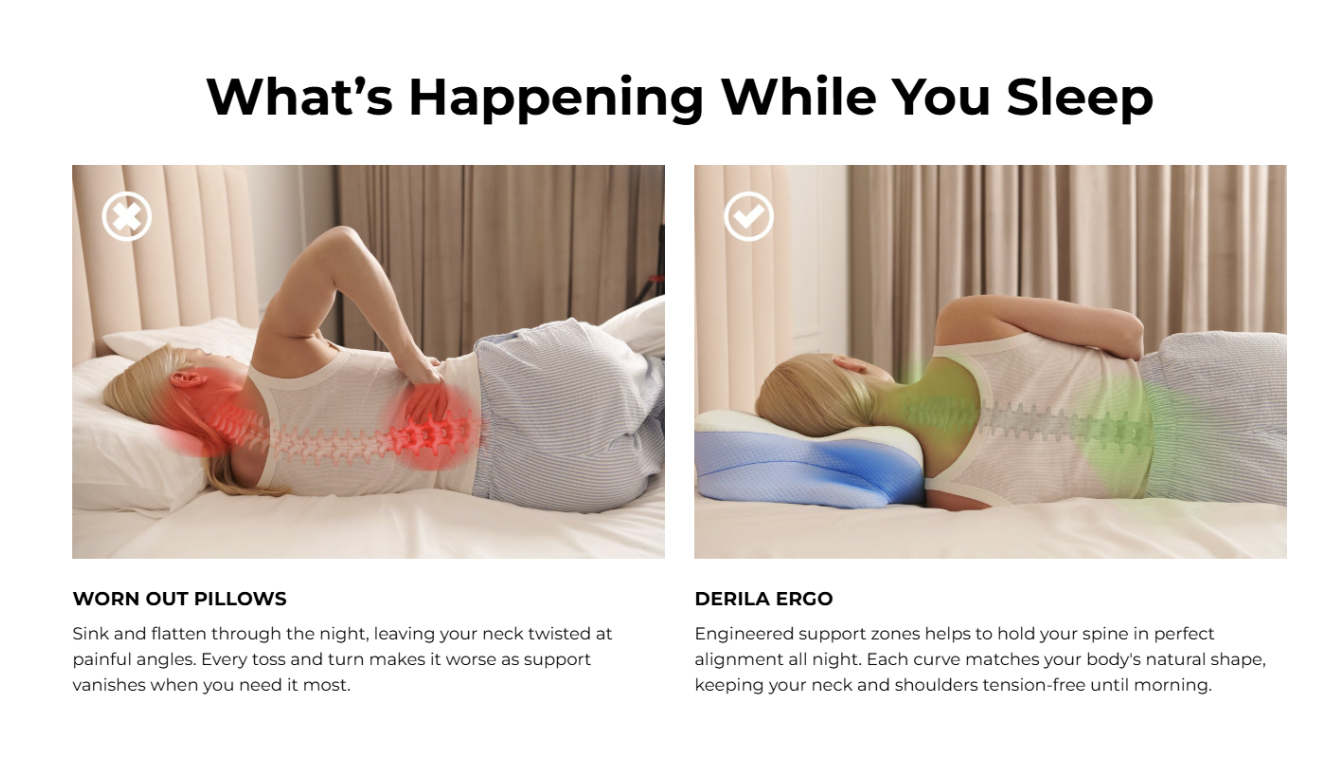
The trade-off: it's structured, not plush. If you want a soft, sink-in pillow, this isn't it. If you sleep hot, latex runs cooler.
Verified purchases. Full reviews, not snippets. Sources noted.
“I have had this pillow for 9 days. It is firm yet squishy and feels good. I will say that when I lay down on it, I guess because it is so structured, I do not have that aaahhh feeling like I did with my favorite L-shaped pillow, but in the past nine days I have slept through the night almost every single night without having to roll over from pain in my neck and upper back and shoulder hurting. I also fall asleep faster.”
“I am a side sleeper. I have wide shoulders with neck and back issues. This thing works! I use a regular pillowcase on it and it fits fine. You turn it one way for back sleeping and the other way for side sleeping. I did not realize this at first, so I had it turned for back sleeping but I still slept through the night. When I figured it out and turned it around my neck is so much more supported. When you have it the wrong way for side sleeping it felt like it filled up my ear with pillow. It is not hot and it's very supportive.”
“I've been a side sleeper my whole life and for the last few years I'd wake up with a stiff neck almost every morning. I tried a memory foam pillow, then a buckwheat one, then went back to a regular pillow. Nothing worked. I bought this one because the shape looked different and I figured I had nothing to lose.”
“The first two nights were weird — it felt too firm and I almost gave up. By night four something clicked. I started waking up without the usual ache. It's been about six weeks now and I haven't had a bad morning since. I don't know if it's the shape or the height, but it keeps my head in a position where my neck doesn't have to fight the pillow all night. I'd buy it again.”
“I'm a combination sleeper — mostly side, sometimes back. I have broad shoulders and a firm mattress, which for years meant I either woke up with a sore neck or a numb arm. I'd tried three different pillows before this one and none of them lasted more than a month before I gave up.”
“This pillow is the first one where I haven't had to choose between side and back comfort. The raised sides actually fill the gap under my neck when I'm on my side, and when I roll onto my back the dip in the middle keeps my chin from being pushed forward. It took about a week to get used to, but the difference in the mornings is real. No more headache, no more shoulder ache.”
“I bought this for my husband, who is a side sleeper with wide shoulders and has been snoring for years. He was skeptical because he'd tried memory foam before and said it made his neck worse. I told him to give it a week.”
“By day five he stopped snoring. I'm not exaggerating — I actually checked on him the first night because the silence woke me up. He says his neck doesn't hurt anymore either, and he's not tossing and turning like he used to. He's been using it for about three months now and it's held up fine. The only complaint is that he wishes the cover was easier to wash, but that's minor.”
The pattern: side sleepers with broader shoulders and neck or shoulder pain report the biggest difference. Stomach sleepers, hot sleepers, and people who want a very soft pillow usually don't.
This is what people actually say
Real threads from r/Pillows. Names hidden. The pattern is always the same.
"Pillow recommendation that won't continue to destroy my neck and shoulders"
"Why can't we find a good pillow???"
"I'm so sick of buying pillows."
In almost every thread, the pillow that failed was bought for the wrong reason — firmness when the problem was height, or material when the problem was the mattress.
The only thing that actually matters: alignment
Not firmness. Not brand. Not "ergonomic" shape. Just: is your head level with your spine?
Quick test: lie on your side and have someone look at you from behind, or take a photo. Your head should be roughly level with your spine. If it tips down, you need more height. If it tips up, less.
Who this is for (and who it isn't)
We'd rather you skip it than buy the wrong thing.
Probably not for you if you…
- Sleep mostly on your stomach
- Want a soft, squishy pillow
- Sleep very hot and need active cooling
- Have a diagnosed cervical condition — ask your doctor first
- Want a fix overnight with zero adjustment
A good fit if you…
- Sleep on your side or back
- Wake up with neck or shoulder stiffness
- Want a firmer, contoured shape
- Sleep cool or normal
- Are willing to give it a week to adjust
The check above gives you a diagnosis. Whether you buy a pillow from us or somewhere else, the diagnosis is the part that actually matters — loft, alignment, and the mismatch between your position and your mattress.